This page provides an overview of Crow's Nest, including basic information about the area along with descriptions of the history and ecology of the peninsula. We invite you to explore and learn!
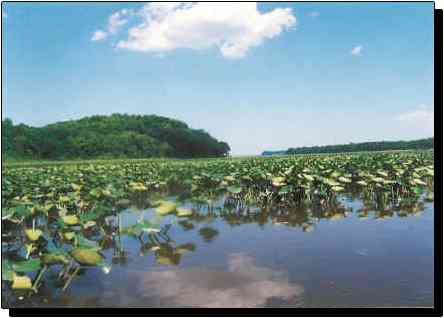 Marshes surround much of Crow's Nest, providing important habitats for many animals. |
|
Crow’s Nest is a nearly 4,000 acre peninsula in
Brief History of Crow’s Nest
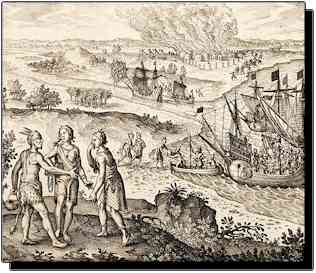
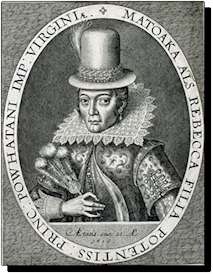
Virginia Historical Society, Richmond, Virginia vahistorical.org
A
print from 1619 (left) depicts the abduction of Pocahontas in the waters
off of Crow's Nest.
The image of Pocahontas (right) was created in 1616 during
her time in England.
Albert Z. Connor Jr., in his book, A History of Our Own: Stafford County, Virginia, has documented the history of Crow’s Nest and surrounding environment.
The Potomacs, Native Americans whose descendants still reside in
The land comprising Crow’s Nest was originally granted to Col. Gerard Fowke.
In 1662, Raleigh Travers received a patent for 3,540 acres on Potomac Creek, encompassing
what is now the heart of Crow’s Nest. A large brick house, “Crow’s
Nest,” was built on a high ridge that paralleled Potomac Creek. The home was named
after The Crow, a black sailing ship owned by
the Travers family. It was harbored in Potomac Creek.
|
The Daniel's family cemetery in Crow's Nest during winter. |
|
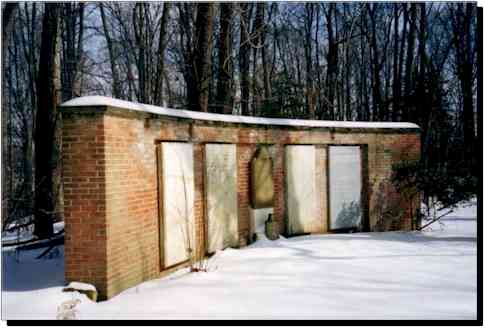

Peter Daniel (1706-1777) married Sarah Travers (1717-1788), daughter of Raleigh
Travers. An advocate of freedom from
Supreme Court Justice Peter Vivian Daniel (1784-1860) and diplomat and Civil War
editor John Moncure Daniel were born in Crow’s Nest.
Like many such properties, Crow’s Nest plantation was destroyed during the
Civil War. Union troops were encamped throughout the Crow’s Nest peninsula. Many
fierce battles and heroic construction efforts took place as opposing troops built,
destroyed and rebuilt supply bridges across Potomac Creek.
Crow’s Nest is a unique wildlife habitat. It is home to nesting bald eagles
and over 1,000 blue herons (the bird that can be seen in the "Save Crow's Nest"
banner logo). It also plays a critical role in supporting migratory bird populations. In
1999, the U.S. Fish and Wildlife Service identified fifty-seven species of neotropical
birds that landed there during the Spring migration.
The Civil War and Crow's Nest [top]
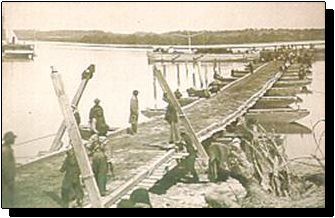
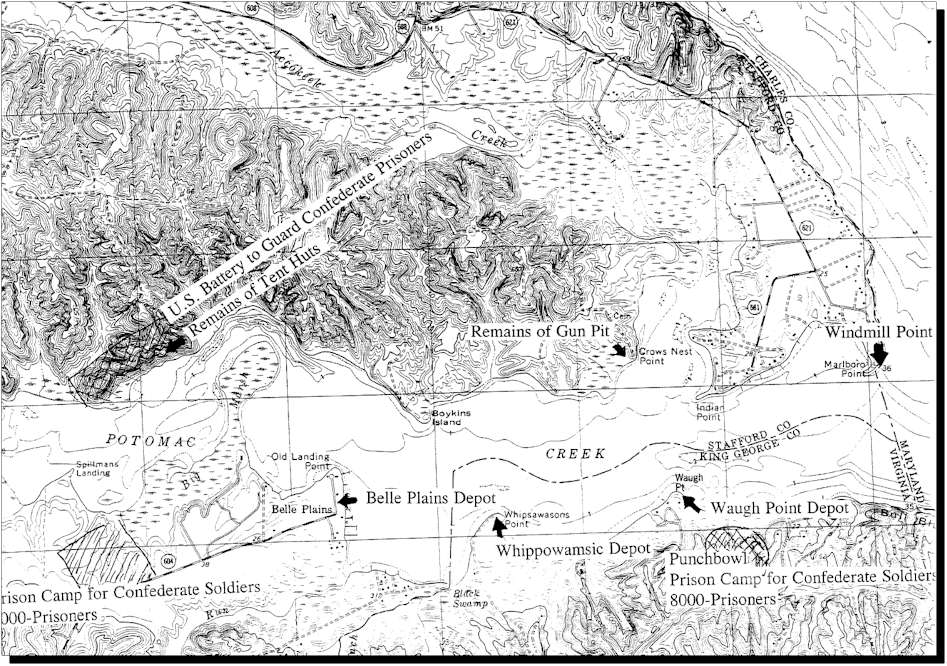 Click
to enlarge
Click
to enlarge
Crow’s
Nest peninsula is in the background of this
The Crow’s
Nest peninsula, home to union soldier encampments during the Civil War, lies just seven
miles east of I-95. The remains of tent huts and a gun pit are on the peninsula itself.
Local lore recounts that soldiers camped here to be near the several taverns
on the
peninsula. But perhaps the most important aspect of Crow’s Nest is the opportunity it
provides to interpret nearby Civil War sites.
Windmill Point,
a union field hospital, was located on Marlborough Point, across from Crow’s Nest. In
his army letters, U.S. Christian Commission field agent John A. Cole described his visit
to the hospital: “I have just come from
Windmill Point Hospital where are about 4,000 sick soldiers, some of them have suffered
terribly and many die daily…. many lives I believe have been saved within the past
three weeks and many souls have passed from darkness into light.” (
Two major Civil War sites are
across Potomac Creek from Crow’s Nest. Neither of these sites is readily accessible
by land. Belle Plains, which was a primary Union supply port during part of the 1864
Overland Campaign, is southwest of Boykin’s
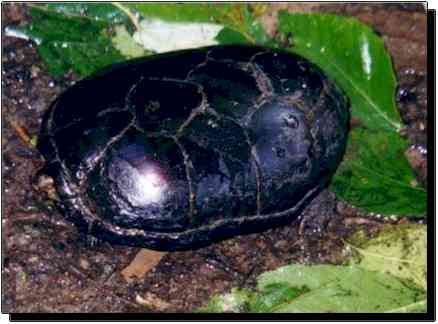
A shy "mud turtle," one of many animals that call Crow's Nest home, retreats in its shell.
Ecological Attributes of Crow's Nest Peninsula [top]
(Prepared July 2002)
A brief summary of some of the peninsula's ecological attributes follows. More details can be found in a report linked at the end of this section.
The Crow's Nest Peninsula consists of 3,500 acres of unfragmented mature hardwood/old growth forest and is the finest remaining example in the mid-Atlantic coastal plain. The Land Acquisition Priority System (LAPS) identifies old growth forests in eastern deciduous biome as an ecosystem undergoing a greater than ninety-eight percent (98%) decline.
Crow’s Nest is an entirely forested peninsula that is five miles long and averages two miles wide. It is one of the largest unfragmented forests in the Chesapeake Bay watershed. In the words of Gary Fleming, Virginia Division of Natural Heritage, "Overall, Crow's Nest supports one of the finest-if not the finest--upland hardwood forests remaining in the Virginia Coastal Plain."
Deep ravine forests at Crow's Nest were identified by the Virginia Department of Natural Heritage as unique "Calcareous Ravine Forests" habitat which has been designated as globally imperiled (G2).
Another rare plant community that is typically associated with the Calcareous Ravine Forest found at Crow's Nest, is the Basic Oak-Hickory Forest (G2 globally imperiled).
Over 1,300 acres of wetlands including 700 acres of freshwater tidal wetlands are found on Potomac and Accokeek Creeks surrounding Crow's Nest Peninsula. These marshes account for 60% of all marshes remaining in Stafford county, Virginia. These freshwater tidal wetlands are undisturbed in a state with forty-two percent (42%) loss of wetlands.
Three bald eagle nests exist at Crow's Nest. The bald eagle (Haliaeetus leucocephalus) is federally listed as threatened. Two nests were active in 2001. Two other bald eagle nests are located nearby. Eagles use the highly productive creeks for feeding and use the forest edge for roosting and nesting habitat. The acquisition of Crow's Nest as a National Wildlife Refuge would directly support the Chesapeake Bay Region Bald Eagle Recovery Plan (amend. 1990).
The short nose sturgeon (Acipenser brevirostrum) a federally listed endangered species has recently been captured at the confluence of Potomac and Accokeek Creeks at Crow's Nest.
Habitat exists for two federally listed plant species, the sensitive joint-vetch (Aeschynomene virginica), and the small whorled pogonia (Isotria medeoloides). The likelihood of finding these species at Crow’s Nest is high as endangered species surveys of the property have not been conducted.
Nineteen Stafford County plant records were identified at Crow's Nest, twelve of which are considered disjunct plant species.
Crow's Nest Peninsula provides nesting, roosting, and migratory habitat for a large number of neotropical migratory land birds and raptors. Fifty seven (57) species were found breeding on Crow's Nest during a survey in the spring of 1999. Sixty percent (60%) of these species are experiencing serious population declines, with forest nesting species experiencing the greatest declines. Ten (10) species are identified as high global priority species by Partners in Flight. Two (2) species are identified as high priority with the Mid-Atlantic Coastal Plain physiographic area (gray catbird and scarlet tanager). Crow's Nest provides habitat for twelve (12) other neotropical migratory bird species experiencing serious population decline in the last 20 years.
At least twenty-five species of waterfowl use the freshwater tidal marshes and wooded swamps for nesting, migration, and wintering habitat. Habitat used by 10 of 13 North American Waterfowl Management Plan Priority species, including Canada Geese, American black ducks, mallards, blue-winged teal, and wood duck are found at Crow’s Nest.
A large 70-acre great blue heron rookery along upper Potomac Creek supporting over 300 nesting pairs is currently protected at Crow's Nest. The "Potomac Creek Heronry" owned by the Northern Virginia Conservation Trust is one of the largest great blue heron rookeries in the Chesapeake Bay watershed.
Potomac and Accokeek Creeks at Crow's Nest provides habitat for five interjurisdictional species, including alewife, striped bass, American eel, American shad, and short nose sturgeon.
Two state listed endangered plant species were identified at Crow's Nest, ginseng (Panax quinquefolius), and the river bullrush (Scirpus fluviatilis).
Sources of information:
Final Environmental Assessment: Proposed Accokeek Creek National Wildlife
Refuge
Virginia Department of Conservation and Recreation,
Division of Natural Heritage.
Preliminary Ecological/Biodiversity Assessment
More detailed information can be found in the U.S. Fish and Wildlife Service's Final Environmental Assessment which is broken into five .pdf files, listed below. This report was done in 2000 for the then-proposed national wildlife refuge. Unfortunately, federal funding for land acquisition was cut, preventing this plan from moving forward. However, good information about the peninsula can be found in this report.
1. The main text, a large file that may take a moment to load
2. Appendix A, a list of the bird and plant species found on Crow's Nest
3. Appendix B, a management plan for the then-proposed national wildlife refuge
4. Appendix C, discussion of compatibility with deer hunting, fishing, etc.
5. Appendix D, the land protection plan