|
Paving the Road to Crow’s Nest
On December 7, 2005, FAMPO
(Fredericksburg Area Metropolitan Planning Organization)—the regional board
that coordinates the area’s transportation planning—took a significant step
towards literally paving the road to Crow’s Nest.
They approved the redirection of funds originally earmarked for projects
that reduce automobile emissions to pay for a
Courthouse Road
project whose stated purpose is to increase
the amount of automobile traffic traveling to the Brooke VRE station.
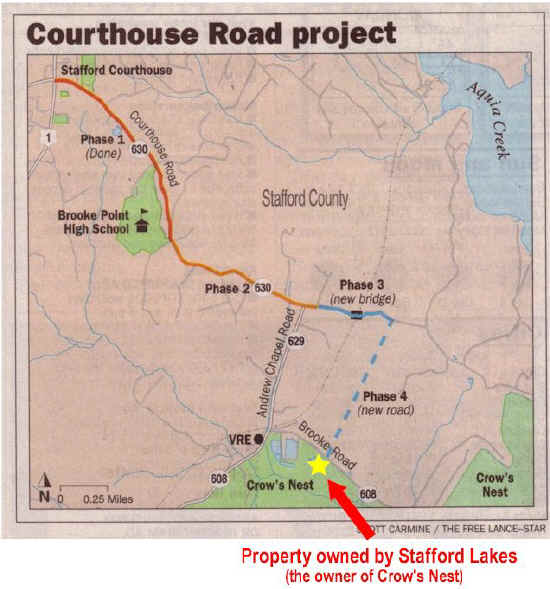
The project is the second in a four-phase effort that would create a new
road that dead-ends at
Stafford
County
’s largest tract of undeveloped land: the Crow’s Nest peninsula.

The
4-phase
Courthouse Road
project plan includes building an
entirely new road that dead-ends at
Stafford
County
’s
largest track of undeveloped land, Crow’s Nest.
That road would facilitate development and dramatically increase traffic
in the area. (Map is from the Free Lance-Star, modified to show the property
owned by Stafford Lakes LP.)
Redirecting
Scarce Transportation Dollars
The
Fredericksburg
region is a “non-attainment” area, meaning ozone levels exceed acceptable
Federal standards. The Federal
government offers localities money to fund projects specifically aimed at
reducing automobile emissions that are the major contributing factor to high
ozone levels. Typical projects
include support for public transportation or bike paths.
FAMPO tried
to use these funds to build the
Courthouse Road
project, arguing it would increase ridership at the nearby commuter rail
station. However, that station is
already operating at capacity (see parking
data), with no plans or funds for expansion.
A government determination ruled that this intended use did not qualify
under the program’s guidelines. As
a result FAMPO had to reclassify these funds to continue the project anyway.
That was the purpose of the December 7th vote.
A
Priority Project?
There was
little attempt at the hearing to justify the move on the grounds that it
would promote commuter rail ridership.
Instead, the plan was touted as one that would straighten a
difficult curve and make the road safer.
Several citizens expressed support for this phase of the project,
citing the dangers of fast-moving cars on
Courthouse Road
. VDOT
data, however, shows only 14 accidents on the road in the last five
years, none of them fatal and only six of them leading to injuries of any
kind.
While there
was little challenge to the point that a straightened curve and wider
shoulders could help with safety issues, numerous speakers raised the
question of whether this project, on a relatively little-used road (see VDOT
traffic count), was really a major transportation priority for the
region. Speakers noted that a
number of the area’s other roads have much heavier traffic congestion,
have more accidents, and are not receiving these funds.
Why, speakers asked, was this road such a priority? |

Outgoing
Aquia District
Kandy
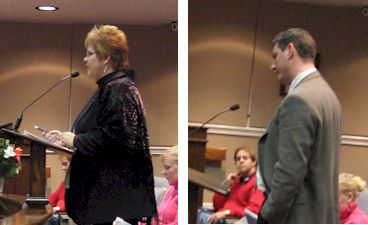
Hilliard, and incoming Supervisor,
Paul Milde, both spoke in favor of Phase 2 of the
Courthouse Road
project.
The complete 4-phase project includes a new road to Crow’s Nest. |
The
Road to Crow’s Nest
One answer to
that question may be seen in the project’s later phases.
Phase III will replace a small bridge on Courthouse Road, allowing heavy
trucks, including concrete trucks and other construction equipment, to travel to
the area. Phase IV would create an
entirely new road that dead-ends precisely at
Stafford
County
’s largest tract of undeveloped land: the Crow’s Nest peninsula. The
presence of such a road would make development on Crow’s Nest and nearby
properties much more feasible. The notice about this hearing sent to residents
who live near the project made no mention of the upcoming third and fourth
phases of the project.
Both the
Aquia District’s outgoing Supervisor, Kandy Hilliard, and Supervisor-elect,
Paul Milde, spoke in favor of the road expansion project.
However, most residents speaking at the public hearing opposed the idea,
citing more pressing transportation needs in the region, the inappropriate use
of funds, and the increased threat to Crow’s Nest.
The FAMPO board is
made up of a combination of elected officials and staff.
Bob Hagan and Randy Wheeler from
Spotsylvania
County
voted against the project. Others,
including Stafford Supervisors Bob Gibbons and Pete Fields, voted in favor.
You can read the local
newspaper coverage of this event in a story
that appeared before the hearing and in a follow-up
story after the hearing.
|